Validation of a methodological model to incubate successful agribusinesses in marginalized areas from South Mexico
DOI:
https://doi.org/10.34117/bjdv9n9-025Keywords:
agribusiness, business plan, poverty, marginalization, competitivenessAbstract
Given the situation of poverty and marginalization in which most of the communities in the rural areas of the Mexican South Southeast are found, a situation that affects 17 million people classified as in a situation of extreme poverty, agribusiness is an alternative under these conditions for it. An operational and practical methodology is required that allows a good identification and implementation of initiatives according to the situation and the environment. The objective of this work was to validate an operational methodological model called model for the competitiveness of small farmers in extreme poverty based on agribusiness. The validation project was developed in four pilot communities in the Mexican South Southeast considered to be highly marginalized and poor: San Andrés Tuxtla, Veracruz; Tahdziu, Yucatan; Ocotepec, Chiapas and San Jerónimo Taviche, Oaxaca. The applied model consists of four stages, diagnosis, incubation, development and maturity. The diagnosis considered in turn two sub-stages, one on the description of the environment and the actors and the second on the definition of the portfolio of opportunities. The incubation considered the sub-stages of prioritization through a qualification criteria and the business plan itself according to the conditions of the actors and the environment. The development stage is nothing more than the start-up and consolidation of the business with a view to continuous improvement. The results obtained were four agribusinesses in progress, one for each pilot community, with profitability indicators such as the Internal Rate of Return (IRR) of 35.0%, 100.0%, 41.0% and 45.9% for jam production in San Andrés Tuxtla Veracruz, Stevia production and marketing in Tadhziu Yucatán, Hass avocado production and marketing in San Pablo Huacanó Chiapas and tomato production and marketing in greenhouses in San Jerónimo Taviche Oaxaca, respectively. The operational methodological model to identify and develop agribusiness in poor and marginalized communities was successfully validated. It is concluded that it is possible to develop profitable and competitive agribusiness in conditions of extreme poverty and marginalization.
References
Andia V.W. y Paucara P.E. 2013. Los planes de negocios y los proyectos de inversión: similitudes y diferencias. Industrial Data, vol. 16, núm. 1, enero-junio, pp. 80-84.
Aquino-Vásquez C., Ramírez-Juárez J., Fuente-Carrasco M. E., Méndez-Espinosa J. A., Pérez-Ramírez N., & Regalado-López J. 2020. La apropiación forestal comunitaria en la sierra Juárez de Oaxaca ante las políticas forestales. Textual, (75), 295-319.
Blanco M. y Gutiérrez S. 2008. El empleo del Modelo de Gestión de la Calidad Total en el sector de la distribución comercial en España: El caso de Mercadona. Universia Business Review, primer trimestre. 24p.
Camacho C.B.I. y Bobadilla S.E.E. 2020. Concepto del agronegocio en México. Revista saber más del Instituto de Investigaciones Agropecuarias y Forestales de la Universidad Michoacana de San Nicolás de Hidalgo No. 53, noviembre. Consultado en: https://www.sabermas.umich.mx/archivo/una-probada-de-ciencia/475-numero-53/916-concepto-del-agronegocio-en-mexico.html
Consejo Nacional de Evaluación de la Política de Desarrollo social (CONEVAL). 2020, Pobreza rural en México. Consultado en: https://www.coneval.org.mx/Medicion/MP/Documents/PATP/Pobreza_rural.pdf.
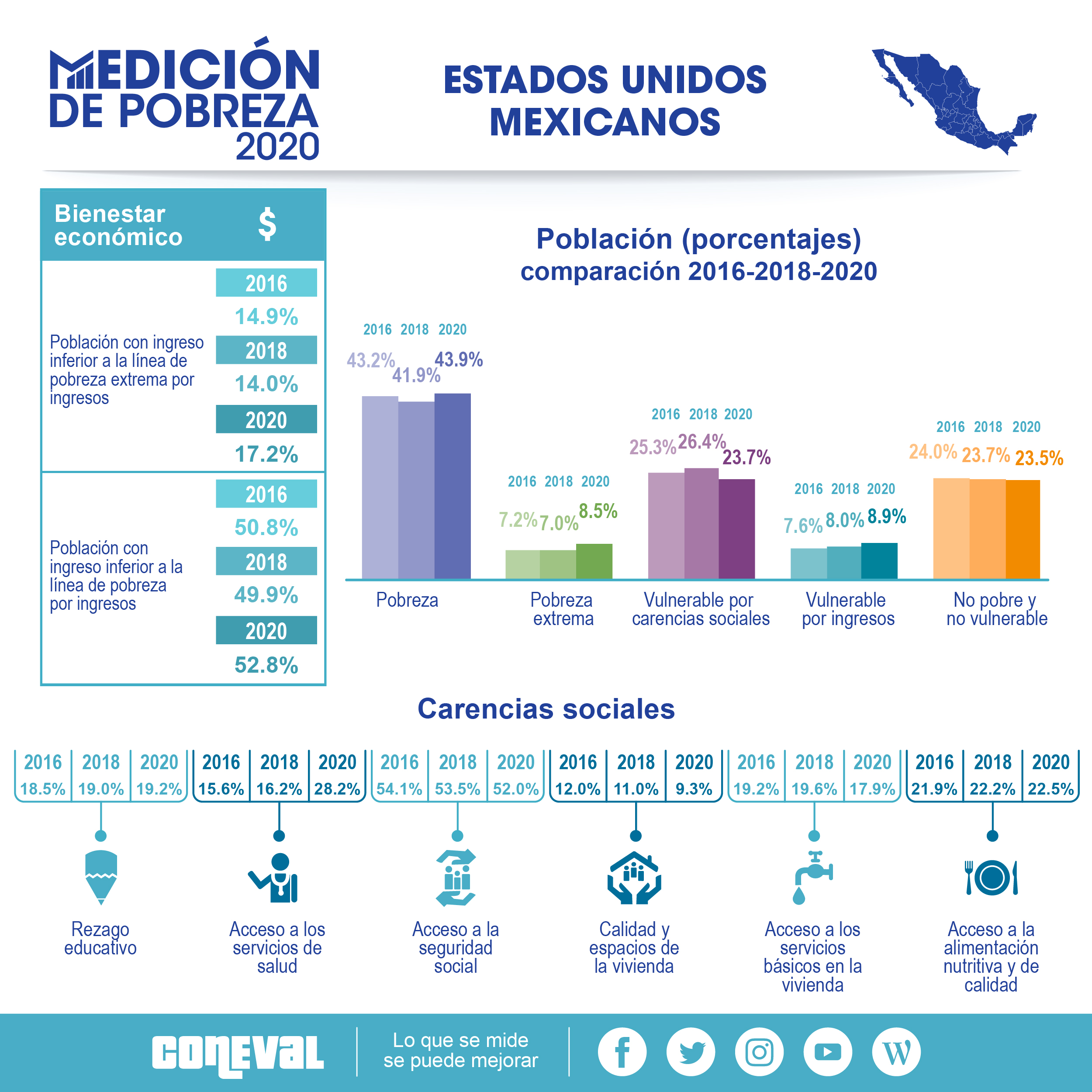
Consejo Nacional de Evaluación de la Política de Desarrollo social (CONEVAL). 2021. Medición de la pobreza 2020, Estados Unidos Mexicanos, consultado en: https://www.coneval.org.mx/Medicion/PublishingImages/Pobreza_2020/Pobreza_2016-2020.jpg.
Instituto Interamericano de Cooperación para la Agricultura (IICA). 2010. Desarrollo de los agronegocios y la agroindustria rural en América Latina y el Caribe: conceptos, instrumentos y casos de cooperación técnica. IICA, San José C.R. 268p.
Rodríguez-H. R., Bravo-M. E., López-L. P., Cadena I.P. 2015. Impact of Sales on the Competitiveness of Marginalized Families, the Case of Tomato Producers from Taviche, Oaxaca, Mexico. Global Advanced Research Journal of Agricultural Science, Vol. 4(7) pp. 325-332.
Rodríguez-Hernández R., Morales-Guerra M., Sánchez-Vásquez V., Cadena-Iñiguez P., y Rendón-Medel R. 2016. Vinculación al mercado y competitividad de unidades campesinas en situación de pobreza en Oaxaca, Guerrero y Chiapas. Revista Mexicana de Ciencias Agrícolas Pub. Esp. Núm. 15, p. 3115-3128.
Rodríguez H. R.; Cadena I. P., Morales G. M., Sánchez V.V. 2019. The Relationship of Private Cost (CPR) as a measure of rural competitiveness. International Journal of Agriculture, Environment and Bioresearch. Vol. 4, No. 05; p. 170-192.
Sastré S.M. 2008. Análisis de la gestión forestal comunitaria y sus implicaciones sociales en Ixtlán de Juárez, Oaxaca, México. Escuela Técnica Superior de Ingenieros de Montes. Universidad Politécnica de Madrid. Madrid. 337p.
Scoponi L., Fernandes P.M.D., Pesce G., Schmidt M.A., Gzain M. 2016. Cooperación Académica en Latinoamérica para la Innovación en los Agronegocios. Journal of Technology Management & Innovation, vol.11 no.2. p. 111-120.